- Members Portal
- ABA Website

ABS Data: CPI now Monthly
16 August 2022
Full Release and Data: ABS
Most advanced countries publish a monthly CPI in line with the International Monetary Fund‘s (IMF) Special Data Dissemination Standards (SDDS). The SDDS sets guidelines for the compilation of statistics for those countries that wish to access international capital markets. Australia is one of only two OECD economies (the other is New Zealand), and the only G20 country, that does not produce a monthly CPI.
Until recently, the costs of producing an Australian monthly CPI have been prohibitive. Enhancements to the quarterly CPI, through the use of new data sources, have reduced data collection costs and made it possible to produce a more frequent measure of household inflation. In particular, the use of scanner data and web-scraping (automated) data collection techniques provide high frequency data at a lower cost.
The recent acquisition of a new monthly data series for rental price information means the ABS now has monthly price data for 43 per cent of the weight of the CPI basket.
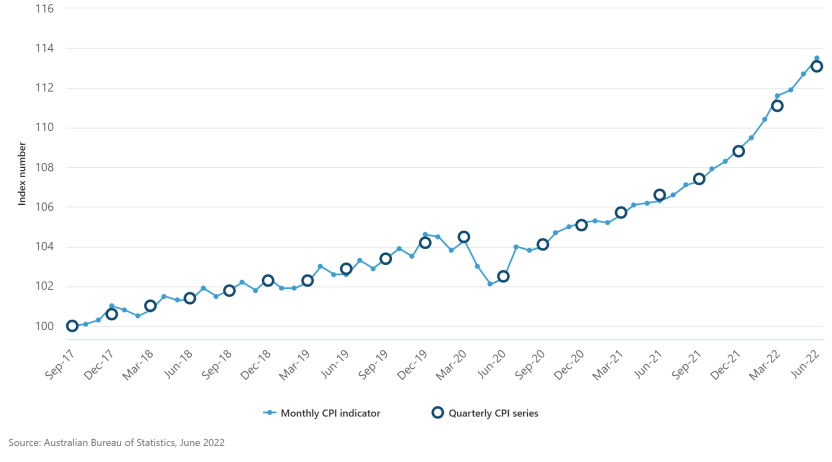
When combined with quarterly and annual price collections, the new monthly CPI indicator represents up-to-date prices for between 62 and 73 per cent of the weight of the CPI basket, depending on the month in the quarterly cycle. Research by the ABS, presented in this paper, shows this information provides a timely indicator of household inflation in Australia.
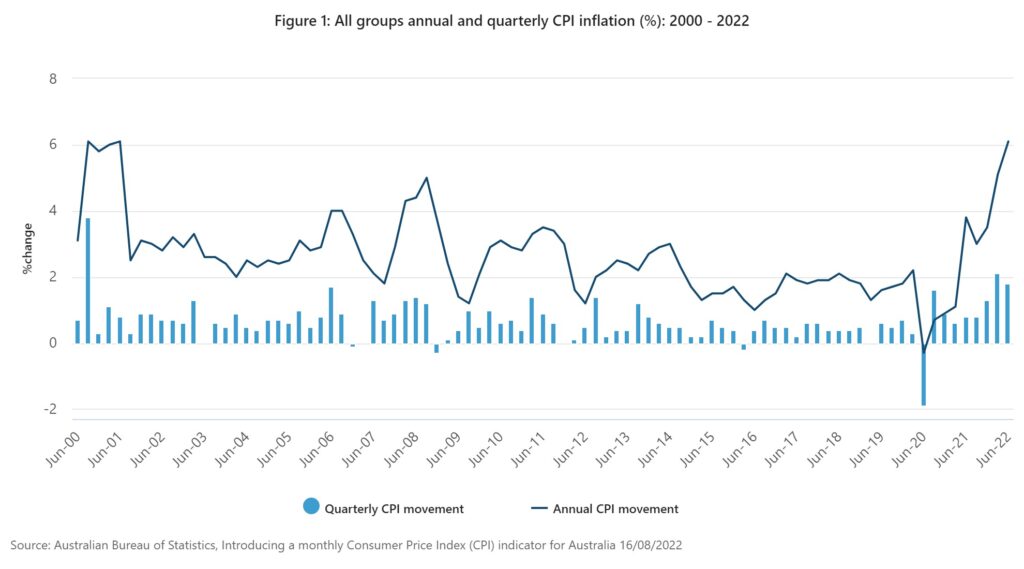
Quarterly CPI
In 2022, annual CPI inflation reached its highest level in 20 years. This has increased the focus on inflation for policy decision making and the cost-of-living experience of Australian households. Inflation is also high in many countries around the world.
Development of a monthly CPI indicator
The ABS has explored whether existing data sources used in the quarterly CPI can also be used to produce a monthly CPI indicator of inflation.
The ABS collects a large volume of data on the prices faced by consumers. The ABS collects these prices at a range of frequencies including weekly, monthly, quarterly and annually.
The frequency of price collection is determined by how often prices typically change and the availability of data. Where price change occurs frequently, such as for food and petrol, weekly and monthly price data is collected for use in the quarterly CPI. Where price change is typically less frequent, such as for restaurant meals and hairdressing services, price data is collected quarterly. In practice, this means that prices collected once a quarter are assumed to reflect the prices for the entire quarter. For series with annual price changes, prices are collected once a year, as in the case of education fees and property rates.
The ABS is producing this monthly CPI indicator recognising there is value in providing more timely consumer price insights, particularly given the current high rate of inflation. While it will be fit for its purpose as a monthly indicator, we note the data collections underpinning it were not designed with monthly reporting of inflation in mind. As a result, the monthly CPI indicator has some deficiencies relative to the quarterly CPI. In particular, the frequency of price collection and the methods used to compile the two indexes will lead to differences between the monthly CPI indicator and the quarterly CPI.
Latest news
Key News: “The Cash Distribution Framework is an important piece of regulatory reform to ensure the continued availability of cash given the decline in its usage and recent uncertainties across the sector.” ABA CEO Simon Birmingham. Media release, 3 September 2026. Media & Communications Update: Political Update: Economic Update: Regulatory Update Upcoming Submissions Selected Media… Read more »
Key News: “You might just think it’s harmless letting somebody access your bank account and getting a few hundred bucks in return, but these are crime syndicates, these are money launderers. You may well be helping to scam a vulnerable Australian out of their life savings.” ABA CEO Simon Birmingham. Interview with 2SM’s Tim Webster,… Read more »
Key News: “Every dollar of bank profits that gets reinvested into bank capital, generates on the analysis we showed this week, $4.70 of economic activity across the Australian economy.” ABA CEO Simon Birmingham. Interview with Ross Greenwood, 21 June. Media & Communications Update: Political Update: Economic Update: Regulatory Update Upcoming Submissions Selected Media Warm regards,The… Read more »