- Members Portal
- ABA Website

Event: RBA Review Panel – Summary of Q&A
29 November 2022
The ABA attended a public CEDA event with the RBA Review Panel, Thursday 24 November
The Panel shared their thoughts and a summary of responses that they have received so far. The Panel were clear that they had not yet landed on final recommendations for their review of the RBA, but shared key themes that had arisen through their consultations, as well as the ways in which they are framing key questions.
The notes below were taken at the time and whilst striving to be accurate, should not be taken as official. They encompass:
- Who the RBA Review Panel has spoken to
- Performance of the RBA
- Thoughts on current governance frameworks
- RBA board composition
- How the panel will make its recommendations
- RBA internal culture
Panellists
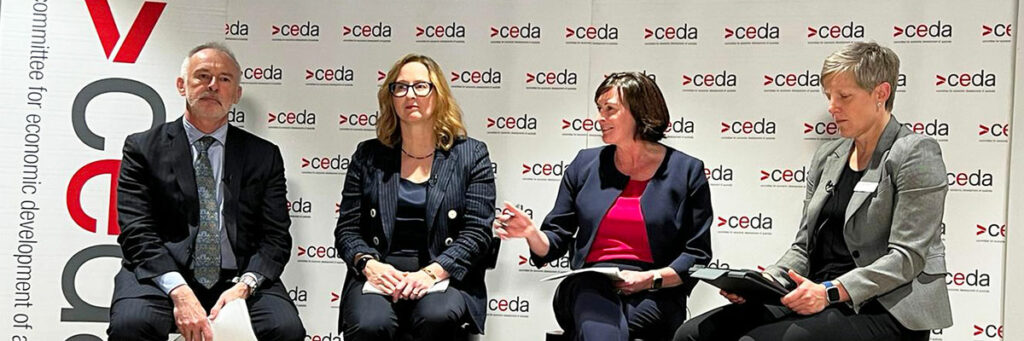
Who has the RBA Review Panel spoken to?
- Many consultations have already been undertaken.
- Spoken to 220 people or so.
- This includes internal RBA staff members, domestic experts, international experts, and other stakeholders.
- Around 100 public submissions have been made. These will be published in coming weeks.
- The Review Panel has surveyed staff at the RBA with over 1,000 responses.
- The RBA Review Panel has commissioned papers from international experts. These will be released when completed, and are currently still being worked on.
Performance of the RBA: How is the Panel thinking about this question?
- The Panel intend to be open and honest about performance, and they also want to ask how the Review can help strengthen the institution for the future.
- Inflation performance over 30 years has been within the target band at 2.4%. That’s a good result.
- Unemployment is at least on par with appropriate international comparisons, perhaps even outperforming.
- Issues with performance arise when you look at specific time periods. For example:
- Low inflation period 2015-19.
- Unconventional policies in pandemic.
- And inflation after the pandemic.
- The Review Panel intends to be clear on the RBA’s performance overall, but to help take lessons for the future.
- For the 2015 to 2019 period:
- Were rates too low?
- Was the Bank sufficiently clear on its reasons for monetary policy in that period?
- 2020-21 Early pandemic:
- Period of extreme uncertainty. Social health and economic shock. In 2020 it was important RBA did extraordinary things then.
- Questions however do arise with regard to the unconventional policies deployed by the RBA, and the use of those tools in Australia.
- This is a mixed report card.
- Likely areas of scrutiny:
- Yield target
- Time based forward guidance.
- Elements of bond purchase program.
- There were significant downsides to the RBA’s unconventional policy tools. It is important to do a full risk analysis before deploying unconventional policy tools. If using unconventional tools, it is important to plan and know how you will get out.
- It is important that decision makers are fully appraised of risks, likely downsides, and exit plans so they have full information in their briefings and deliberations. Was this done?
- 2021 onwards – coming out of the Pandemic:
- The Panel acknowledges the unexpected prevalence of supply shocks, war, after-effects of the pandemic, and floods.
- Maybe the bank was a bit slow in identifying inflationary process.
- No Philips curve anymore?
- Inflation model may not be right.
- Agility required in different contexts, rather than sticking with same frameworks.
Are the current RBA’s current governance frameworks appropriate? How should it be improved?
- Most people agree on the need for an independent RBA.
- Most agree that inflation targeting is working well.
- The Panel is concerned about whether we will have different shocks going forward. For example, climate or geopolitical shocks.
- Some respondents have suggested that nominal income targeting may be better to target than inflation. The panel is looking at different options.
- Fiscal or regulatory policy may be a better lever, some respondents have said.
- Although people are generally happy with 2-3%, the “on average over time” language is unclear to many.
- People want more clarity on the weightings that the RBA gives to the inflation and employment targets in making their decisions.
- Economic prosperity point: some people want more to be included in that statement, such as references to climate, house prices etc. Others want the language of ‘economic prosperity’ to be taken out because it’s too flexible and thereby doesn’t hold the Bank accountable.
Board composition
- The role of the Treasury Secretary has been raised by many. Is this an independence conflict? Some respondents say yes, some say no.
- Many comments on transparency of Board decisions and deliberations.
- Many other central banks have separate monetary boards. A key question is whether the current board have the skills and capacity to do both. No decision yet.
How will the RBA Review Panel make its recommendations?
- The Panel will have two sets of recommendations. One set is relevant if Government is minded to open the Act. The second set of recommendations will be applicable if Government decides it will not open the Act.
- The recommendations will be made on the basis of what the Panel believes will be best for the RBA and Australia.
- It was noted that Canada does a 5 yearly review on their central banks inflation targeting effectiveness. So there could be potentially more RBA reviews to come in future, as economy changes.
RBA internal culture
- There have been changes in recruitment to drive change. This is a work in progress.
- There are issues with hierarchy and risk. A ‘top-down culture’. A key question is how do you help people do their jobs rather than shift decisions upwards. Bank has work to do with regard to hierarchical culture.
- Silos another issue. Economic and financial parts of the bank especially. This is still an impediment to open decision making.
- Leadership and professional development can be improved. It is important to note that it is not sufficient to be a good economist, but also should be a good leader. Bank moving toward that but a work in progress.
- How inclusive and diverse is the bank? Not in terms of ‘wokeness’, but with regard to effectiveness and efficiency. The Bank is not yet gender balanced. The Bank also doesn’t yet reflect the Australian population well.
- Increasing openness and contestability is final point where culture can be improved.
Latest news
Key News: “The Cash Distribution Framework is an important piece of regulatory reform to ensure the continued availability of cash given the decline in its usage and recent uncertainties across the sector.” ABA CEO Simon Birmingham. Media release, 3 September 2026. Media & Communications Update: Political Update: Economic Update: Regulatory Update Upcoming Submissions Selected Media… Read more »
Key News: “You might just think it’s harmless letting somebody access your bank account and getting a few hundred bucks in return, but these are crime syndicates, these are money launderers. You may well be helping to scam a vulnerable Australian out of their life savings.” ABA CEO Simon Birmingham. Interview with 2SM’s Tim Webster,… Read more »
Key News: “Every dollar of bank profits that gets reinvested into bank capital, generates on the analysis we showed this week, $4.70 of economic activity across the Australian economy.” ABA CEO Simon Birmingham. Interview with Ross Greenwood, 21 June. Media & Communications Update: Political Update: Economic Update: Regulatory Update Upcoming Submissions Selected Media Warm regards,The… Read more »