- Members Portal
- ABA Website

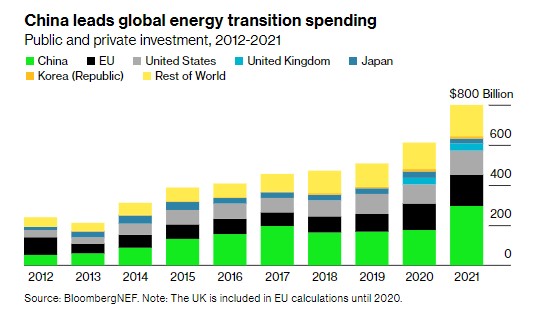
China climate transition spending dwarfs rest of world
16 August 2022
When you combine public and private investments aimed at accelerating the energy transition, China is by far and away the biggest spender, according to data compiled by energy research group Bloomberg NEF. Neither the IRA nor Europe’s Green Deal appears likely to change that. China spent $297.5 billion last year on the energy transition, while EU member states devoted $155.7 billion and the US $119.7 billion, using the BNEF methodology.
Carbon pricing has long been championed by economists as a first step toward decarbonization and has been embraced by dozens of nations, although debates about its effectiveness rage. A growing group of political scientists argues that a better approach is to make clean energy and greener technologies more accessible, much like the approach now being taken by the US.
The EU’s Green Deal, approved in 2020, aims to retool how the continent’s economy works by redesigning everything from farming to how cities are built. The bloc plans to spend 30% of its €2 trillion budget for 2021-2027, or about €600 billion ($612 billion), to fight climate change, and that doesn’t include individual member state investments and subsidies, according to the research firm Rhodium Group.
The IRA includes funding for a new federal green bank. That $27 billion is “dwarfed” by Germany’s state-owned development bank KfW, which has assets of about $500 billion and is a “critical source of capital” for green projects worldwide, notes Kelly Sims Gallagher, director of the Climate Policy Lab at Tufts University’s Fletcher School.
“While the Inflation Reduction Act will mobilize unprecedented amounts of investment into clean energy in the United States for the next decade, China and the EU are spending as much or more,” Gallagher said.
In China, much of that money is being directed at a world-leading expansion of wind and solar, which was supercharged when President Xi Jinping said in 2020 that the nation is aiming to be carbon neutral by 2060. The buildout of renewable generation in China has been so successful that it now threatens farmland and authorities are seeking to balance new solar installations with food security.
Latest news
Key News: “The Cash Distribution Framework is an important piece of regulatory reform to ensure the continued availability of cash given the decline in its usage and recent uncertainties across the sector.” ABA CEO Simon Birmingham. Media release, 3 September 2026. Media & Communications Update: Political Update: Economic Update: Regulatory Update Upcoming Submissions Selected Media… Read more »
Key News: “You might just think it’s harmless letting somebody access your bank account and getting a few hundred bucks in return, but these are crime syndicates, these are money launderers. You may well be helping to scam a vulnerable Australian out of their life savings.” ABA CEO Simon Birmingham. Interview with 2SM’s Tim Webster,… Read more »
Key News: “Every dollar of bank profits that gets reinvested into bank capital, generates on the analysis we showed this week, $4.70 of economic activity across the Australian economy.” ABA CEO Simon Birmingham. Interview with Ross Greenwood, 21 June. Media & Communications Update: Political Update: Economic Update: Regulatory Update Upcoming Submissions Selected Media Warm regards,The… Read more »