- Members Portal
- ABA Website

AOFM: High demand for May 2032 bonds, despite high volatility
21 July 2022
- Cash buffers are key amid volatility, AOFM’s Nicholl says
- Regulatory changes have led to thinner liquidity, he says
Matthew Burgess, Bloomberg
Australia’s debt management agency has a strategy for issuing bonds in this year’s volatile and liquidity-plagued markets: hold cash and don’t tell people what you’re doing, at least not too soon.
The Australian Office of Financial Management doesn’t announce its debt sales until a week before an auction, giving it the flexibility to issue along the curve in areas where primary dealers are seeing high demand, according to chief executive Rob Nicholl. If stress is too high, the funding arm can hold back and use cash buffers to meet the government’s funding needs, he said.
“Not setting highly prescriptive expectations about what issuance is going to be gives us week-to-week flexibility” unlike peers that announce their plans over a three-month period, Nicholl said in an interview. “That’s a really important thing.”
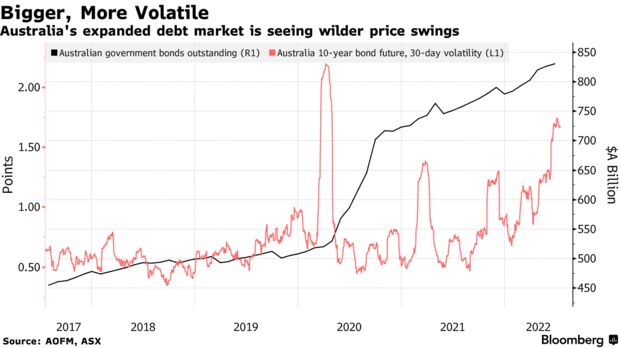
Demand for Australian debt auctions has remained robust even as volatility in the securities has surged to a decade high. Traders have complained about a lack of liquidity, echoing sentiment in the US. Australia’s sale of bonds maturing in May 2032 on Wednesday attracted three times as many buyers as the amount offered, near the highest this year for similar-dated debt, according to AOFM data.
Read more: Single Buyer Snaps Up All A$1 Billion Australia Bonds at Auction
Nicholl said the lack of liquidity in debt markets can be blamed on a range of factors, including investors unwilling to trade during periods of volatility. Banks have also removed market-making capacity during times of stress as a result of regulatory changes stemming from the Global Financial Crisis, he said.
Read More: Treasury Volatility Puts Lessons of March 2020 Squarely in Focus
Market-making capacity hasn’t kept pace with the expansion in borrowing that was fueled by quantitative-easing programs, meaning there’s a lack of depth compared with five-or-10 years ago, Nicholl said. “Put all of that together you think to yourself ‘OK, I can see why there are times when liquidity looks shallow’.”
The US Treasury is assessing how to address it, though there’s no clear answer. For Australia’s funding needs, Nicholl says the solution is a flexible approach to issuance and holding a cash buffer.
“We can’t predict the future,” he said. “If we were find to find ourselves involuntarily in a period where markets close, which they did in March 2020, what can we do? Well we don’t have to issue because we’ll always have some cash on hand and then we’ll just pick that up later.”
Latest news
Key News: “The Cash Distribution Framework is an important piece of regulatory reform to ensure the continued availability of cash given the decline in its usage and recent uncertainties across the sector.” ABA CEO Simon Birmingham. Media release, 3 September 2026. Media & Communications Update: Political Update: Economic Update: Regulatory Update Upcoming Submissions Selected Media… Read more »
Key News: “You might just think it’s harmless letting somebody access your bank account and getting a few hundred bucks in return, but these are crime syndicates, these are money launderers. You may well be helping to scam a vulnerable Australian out of their life savings.” ABA CEO Simon Birmingham. Interview with 2SM’s Tim Webster,… Read more »
Key News: “Every dollar of bank profits that gets reinvested into bank capital, generates on the analysis we showed this week, $4.70 of economic activity across the Australian economy.” ABA CEO Simon Birmingham. Interview with Ross Greenwood, 21 June. Media & Communications Update: Political Update: Economic Update: Regulatory Update Upcoming Submissions Selected Media Warm regards,The… Read more »